From Reels to Brims: How a Paper Hat Manufacturer Works With Yarn-Spun Paper
Working as a paper hat manufacturer means handling yarn spun from kraft paper. Five weights, two routes, and why paper now sits next to straw and synthetics.
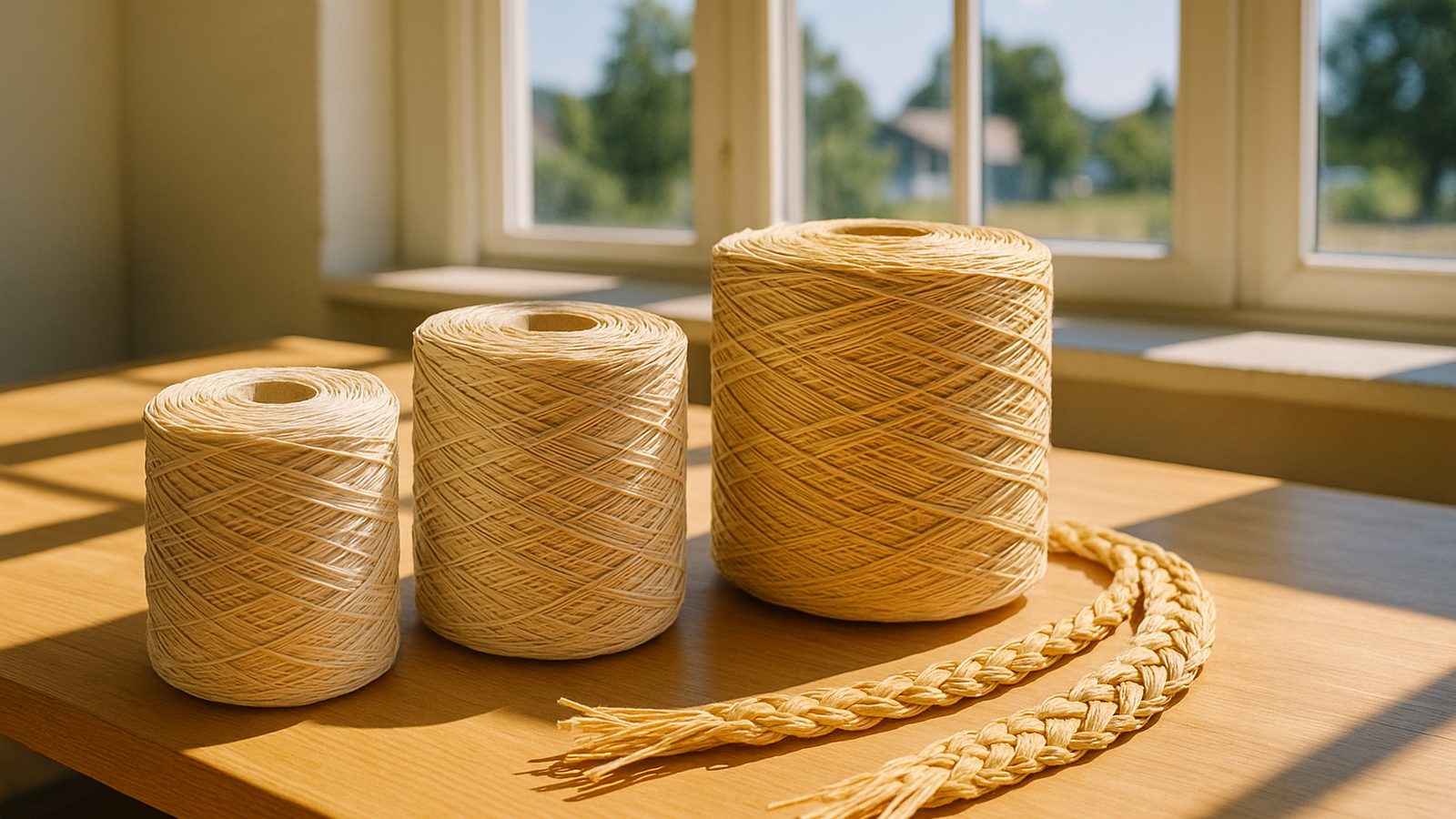
When a brand brief asks for the look of natural plant fiber without the supply variability that comes with a crop year, the answer is almost always paper. Working as a paper hat manufacturer means understanding a category that did not exist at scale a generation ago and now sits next to natural and synthetic fibers as one of three material systems — 5 paper materials, alongside 7 natural and 5 synthetic, in our 17-material library in our materials library. The question we get most often from new clients is the same: where does the paper actually come from, and how does it become a hat?
What Paper Yarn Actually Is
Paper yarn begins as a roll of kraft paper, slit into ribbons a few millimeters wide, then twisted into a continuous yarn on a spinning frame. The twist is what gives it strength. A flat paper strip would crease and tear at the first stretch, but a twisted yarn handles braiding tension as cleanly as natural straw. From there the process diverges into two paths: braided into hat bodies, or woven on jacquard looms into more structured constructions. Both feed the paper section of our hats catalogue. A paper hat manufacturer has to make a choice the natural-fiber side does not: how tight to twist the yarn. A loose twist gives a softer, more matte hand. A tight twist gives a glossier, harder surface that holds a crown shape longer. We carry five paper-yarn weights in active production, which is why the Paper category inside our materials library currently runs five distinct fabrications.
Why a Paper Hat Manufacturer Treats It Differently Than Straw
Straw is harvested. Paper is made. That difference shows up everywhere. A paper hat manufacturer can order yarn against a spec sheet — color, weight, twist, source documentation — and receive the same product in March and September. A wheat or raffia order is bounded by the crop year. For a brand running a season-over-season repeat program, that predictability is the entire reason paper exists as a category.
The other difference is dyeing. Paper yarn dyes pre-spin in a way that gives flatter, more uniform color than the post-braid dye baths most natural straws require. For clients who care about lot-to-lot color consistency — and at this point that includes most retail programs we run for buyers like T.J.Maxx and Costco — paper is the friendlier substrate.
What a Paper Hat Manufacturer Makes With the Material Today
Across both our China and Cambodia bases, we run paper-yarn programs for braided fedora, bucket-hat, and visor silhouettes, along with crossover paper-and-cotton accessory pieces in our braided bag line. The same paper yarn that becomes a brim becomes a handle. We share fiber across hat and bag programs intentionally — for a paper hat manufacturer, the cross-fiber model is one of the reasons the Paper category remains profitable at the smaller MOQs newer brands need.
Where a Paper Hat Manufacturer Fits in the Brand Brief
When a new client opens a brief with us, paper tends to come in late — after the natural-fiber options have been priced and the supply windows have been weighed. That is usually the right order. Paper is rarely the first material a designer falls in love with, but it is often the one a buyer chooses for the second order, when the question becomes how to repeat the program at scale without the surprises that come with a natural-crop year.
We do not think of paper as a substitute for natural fiber. It is its own material with its own rules. A paper hat manufacturer who treats it as a fallback ends up with a fallback product. Treated as what it is — a stable, dye-friendly fiber with a clean documentation chain — it carries entire seasons cleanly. The brim looks different. The economics look different. The right brief makes both work.